

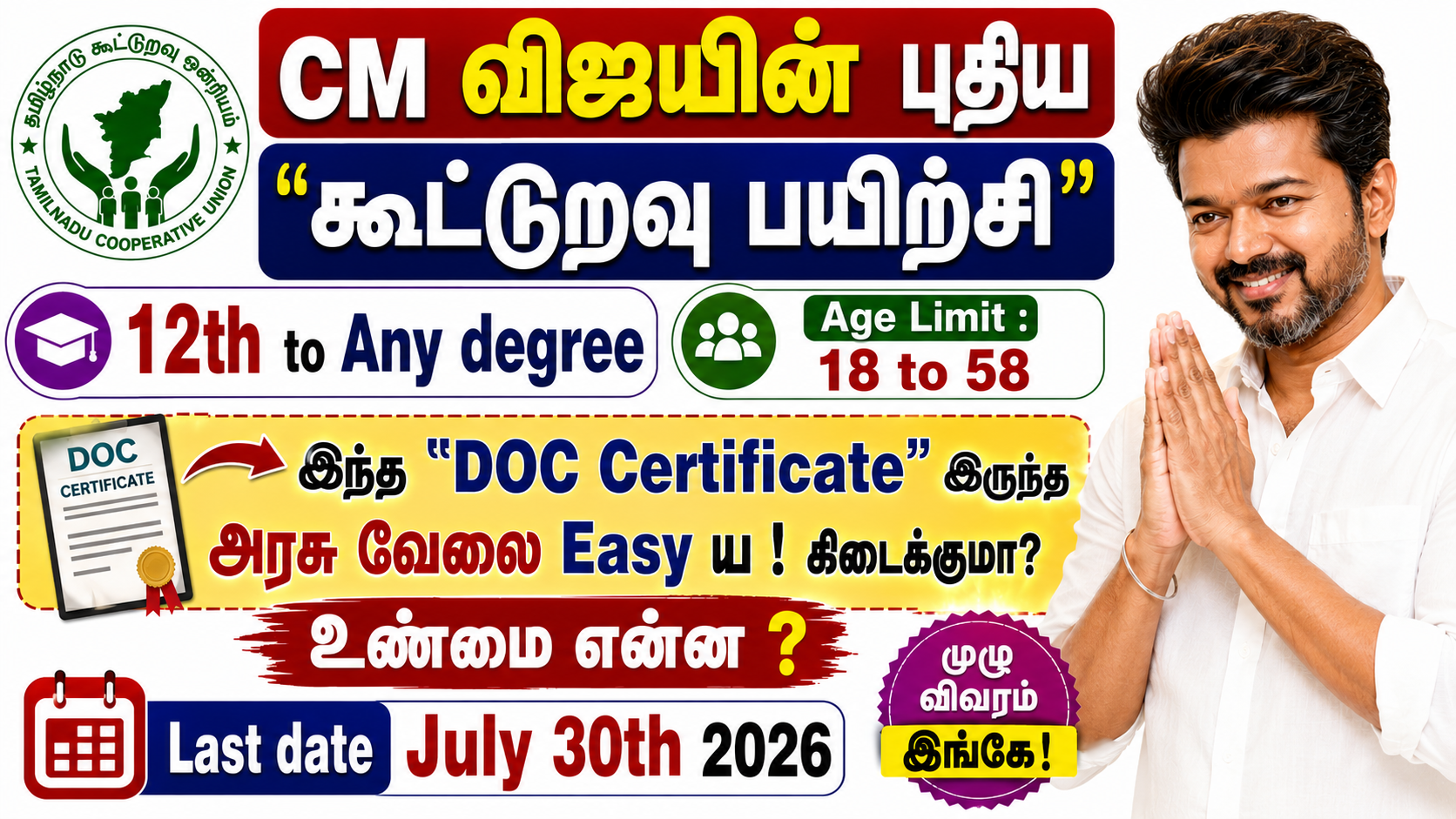
Diploma in Cooperative Management 2026–27. A Gateway to Careers in Cooperative Institutions.The Tamil Nadu Cooperative Union (TNCU) has officially invited online applications for admission to the Diploma in Cooperative Management (DCM) – Regular Course for the Academic Year 2026–2027. This prestigious one-year professional diploma program is conducted through Cooperative Management Institutes functioning under the Tamil Nadu Cooperative Union.
The course is specifically designed to equip students with comprehensive knowledge of cooperative administration, banking, auditing, accounting, management principles, and jewel appraisal techniques. Successful completion of this diploma enhances employment opportunities in cooperative banks, credit societies, cooperative institutions, and other financial organizations.
Candidates meeting the prescribed eligibility conditions can submit their applications through the online admission portal within the specified application period.
Table of Contents
Highlights of Diploma in Cooperative Management 2026–27
| Particulars | Details |
|---|---|
| Course Name | Diploma in Cooperative Management (DCM) |
| Academic Year | 2026–2027 |
| Course Type | Full-Time Regular Course |
| Course Duration | 1 Year |
| Training Mode | Classroom & Practical Training |
| Medium of Instruction | Tamil |
| Application Mode | Online Only |
| Conducting Authority | Tamil Nadu Cooperative Union (TNCU) |
| Eligibility | +2 Pass / Degree Holders |
| Minimum Age | 17 Years |
| Maximum Age | No Upper Age Limit |
About the Diploma Program
The Diploma in Cooperative Management is a specialized professional training program developed to strengthen the cooperative sector by creating skilled and qualified professionals.
The curriculum focuses on:
- Cooperative Principles and Practices
- Cooperative Banking Operations
- Cooperative Auditing
- Financial Accounting
- Cooperative Administration
- Information Technology Applications
- Jewel Appraisal Techniques
- Credit and Non-Credit Cooperative Societies
- Practical Field Training
Students will receive both theoretical knowledge and practical exposure to real-world cooperative operations.
Eligibility Criteria
Applicants must satisfy the following educational requirements:
| Qualification | Eligibility |
| Higher Secondary (+2) | Eligible |
| 10+2 + 3-Year Degree | Eligible |
| Graduates from Any Discipline | Eligible |
Age Requirement
Candidates should have completed a minimum age of 17 years as on 01 July 2026.
| Criteria | Details |
| Minimum Age | 17 Years |
| Maximum Age | No Limit |
This open age policy allows fresh students, graduates, job seekers, and working professionals to pursue the course.
Reservation and Community Certificate Requirements
Applicants belonging to the following categories must upload a valid Community Certificate while submitting their application:
- Scheduled Castes (SC)
- Scheduled Tribes (ST)
- Most Backward Classes (MBC)
- Backward Classes (BC)
Failure to upload the prescribed certificate may result in the applicant not being considered under the reserved category quota.
Attendance Regulations
Strict attendance norms have been introduced to ensure academic discipline and quality training.
Important Attendance Rules
✔ Attendance will be recorded exclusively through the Biometric System.
✔ Students must maintain a minimum of 80% attendance in each semester.
✔ Only candidates fulfilling the attendance requirement will be eligible to appear for the final examination.
✔ Students failing to achieve the minimum attendance percentage will not be permitted to write the final examination under any circumstances.
✔ Candidates who clear the first semester but fail to maintain attendance requirements in the second semester may not be allowed to continue the course.
These regulations are intended to maintain the professional standards of the diploma program.
Detailed Fee Structure
The following fees are applicable for the 2026–27 academic session:
| Fee Particulars | Amount (₹) |
| Tuition Fee | 8,000 |
| Application & Registration Fee | 100 |
| Diary Fee | 300 |
| Stationery Charges | 600 |
| Examination & Certificate Fee | 2,500 |
| Book Charges | 2,000 |
| Library Deposit (Refundable) | 300 |
| Postal Charges | 207 |
| Cooperative Journals & Publications | 500 |
| Sports Fee | 150 |
| Computer Training Fee | 1,500 |
| Jewel Appraisal Training Fee | 4,543 |
| Identity Card Fee | 150 |
| Total Fee | ₹20,850 |
Fee Payment Instructions
| Particulars | Amount |
| Application Fee | ₹100 |
| Training Fee | ₹20,750 |
| Payment Method | Online Only |
Important Guidelines
- The entire course fee must be paid in a single installment.
- Fees once paid will not be refunded.
- Transfer between training institutes will not be permitted.
- Payment should be completed through the official online portal only.
Course Structure and Duration
The Diploma in Cooperative Management follows a semester-based structure.
Duration
One Academic Year
- Semester I – 6 Months
- Semester II – 6 Months
The program includes classroom instruction, practical sessions, project work, and field exposure.
Semester-Wise Subjects
Semester I
| Subject Code | Subject Name |
| Paper 1 | Cooperative Theory and Practice |
| Paper 2 | Cooperative Law and Related Legislations |
| Paper 3 | Financial Accounting |
| Paper 4 | Cooperative Management and Administration |
| Paper 5 | Computer Management and Information Systems |
Semester II
| Subject Code | Subject Name |
| Paper 6 | Cooperative Audit |
| Paper 7 | Cooperative Banking |
| Paper 8 | Jewel Appraisal and Valuation Techniques |
| Paper 9 | Non-Credit Cooperative Institutions |
| Paper 10 | Practical Training, Field Study and Project Report Preparation |
Examination Pattern
The final examination is conducted exclusively in Tamil using objective-based question formats.
Marks Distribution
| Subject | Assessment Pattern |
| Papers 1–9 | Written Exam (30 Marks) + Internal Assessment (10 Marks) |
| Paper 10 | Written Exam (20 Marks) + Internal Assessment (10 Marks) + Field Training (10 Marks) |
Minimum Passing Requirement
Candidates must secure at least 40% marks in each subject to qualify.
Classification of Results
| Percentage | Class Awarded |
| 40% – 59% | Second Class |
| 60% – 74% | First Class |
| 75% and Above | Distinction |
Students securing distinction can significantly enhance their employment prospects in cooperative institutions and financial organizations.
Code of Conduct
Students admitted to the institute must strictly adhere to institutional regulations and disciplinary guidelines.
Important Rules
- Maintain regular attendance.
- Follow institute policies and academic regulations.
- Participate actively in classroom and practical sessions.
- Maintain professional conduct throughout the course.
Students violating institutional rules may face disciplinary action, including removal from the program without prior notice.
Required Documents for Online Application
Applicants should keep the following documents ready before applying:
| Required Document |
| SSLC Mark Sheet |
| Higher Secondary (+2) Mark Sheet |
| Degree Certificate (if applicable) |
| Transfer Certificate (TC) |
| Community Certificate |
| Passport Size Photograph |
| Digital Signature |
Scholarship Information
Applicants seeking educational assistance or scholarship benefits must provide:
For +2 Students
EMIS Number (as mentioned in the Higher Secondary Certificate)
For Degree Holders
UMIS Number (as mentioned in the College Records)
Providing these details is mandatory during the application process.
Important Dates
| Event | Date |
| Online Application Starts | 08 June 2026 |
| Last Date to Apply | 20 July 2026 (5:00 PM) |
| Publication of Eligible Candidate List | 22 July 2026 |
| Certificate Verification & Admission | 22 July 2026 to 31 July 2026 |
| Course Commencement | 03 August 2026 |
Applications submitted after the deadline will not be accepted under any circumstances.
🔗Diploma in Cooperative Management 2026–27 & Apply Link Table 🔗
| 🔗 Resource | 👉 Apply/View Link |
|---|---|
| 🧾Diploma in Cooperative Management 2026–27 Career Page | CLIKCHERE |
| 📝 Diploma in Cooperative Management 2026–27 Apply Link | CLIKCHERE |
| 📝 Diploma in Cooperative Centre District List | CLICKHERE |
Career Opportunities After Completing DCM
Successful candidates can explore employment opportunities in:
- Cooperative Banks
- Agricultural Cooperative Societies
- Credit Cooperative Institutions
- Urban Cooperative Banks
- Primary Agricultural Credit Societies
- Cooperative Marketing Federations
- Cooperative Housing Societies
- Jewel Loan Departments
- Financial Service Organizations
The diploma serves as a valuable qualification for candidates aspiring to build careers in the cooperative and banking sectors.
Final Conclusion
The Diploma in Cooperative Management (Regular) 2026–27 is an excellent professional qualification for students, graduates, and job aspirants seeking rewarding careers in cooperative institutions and banking services. With a structured curriculum, practical training modules, cooperative banking specialization, and jewel appraisal certification, this program provides comprehensive industry-oriented knowledge.
Interested candidates should complete their online application process well before the closing date and ensure that all required documents are uploaded correctly to avoid rejection.
Apply for Diploma in Cooperative Management (DCM) Regular Course 2026–27. Check eligibility, age limit, fee structure, subjects, admission process, online application, important dates, cooperative banking career opportunities, and complete course details.
Diploma in Cooperative Management 2026, DCM Admission 2026 Tamil Nadu, Cooperative Management Course 2026, TNCU Diploma Admission 2026, Cooperative Banking Diploma Course, Cooperative Management Institute Admission, Tamil Nadu Cooperative Union Course, DCM Online Application 2026, Cooperative Banking Jobs Qualification, Diploma in Cooperative Administration, Cooperative Audit Course Tamil Nadu, Cooperative Society Jobs Course, Cooperative Management Training 2026, Jewel Appraisal Diploma Course, Banking Related Diploma Course, Cooperative Management Eligibility, Cooperative Management Fee Structure, Diploma Course After Plus Two, Cooperative Banking Career Course, Tamil Nadu Cooperative Course Admission 2026.

