

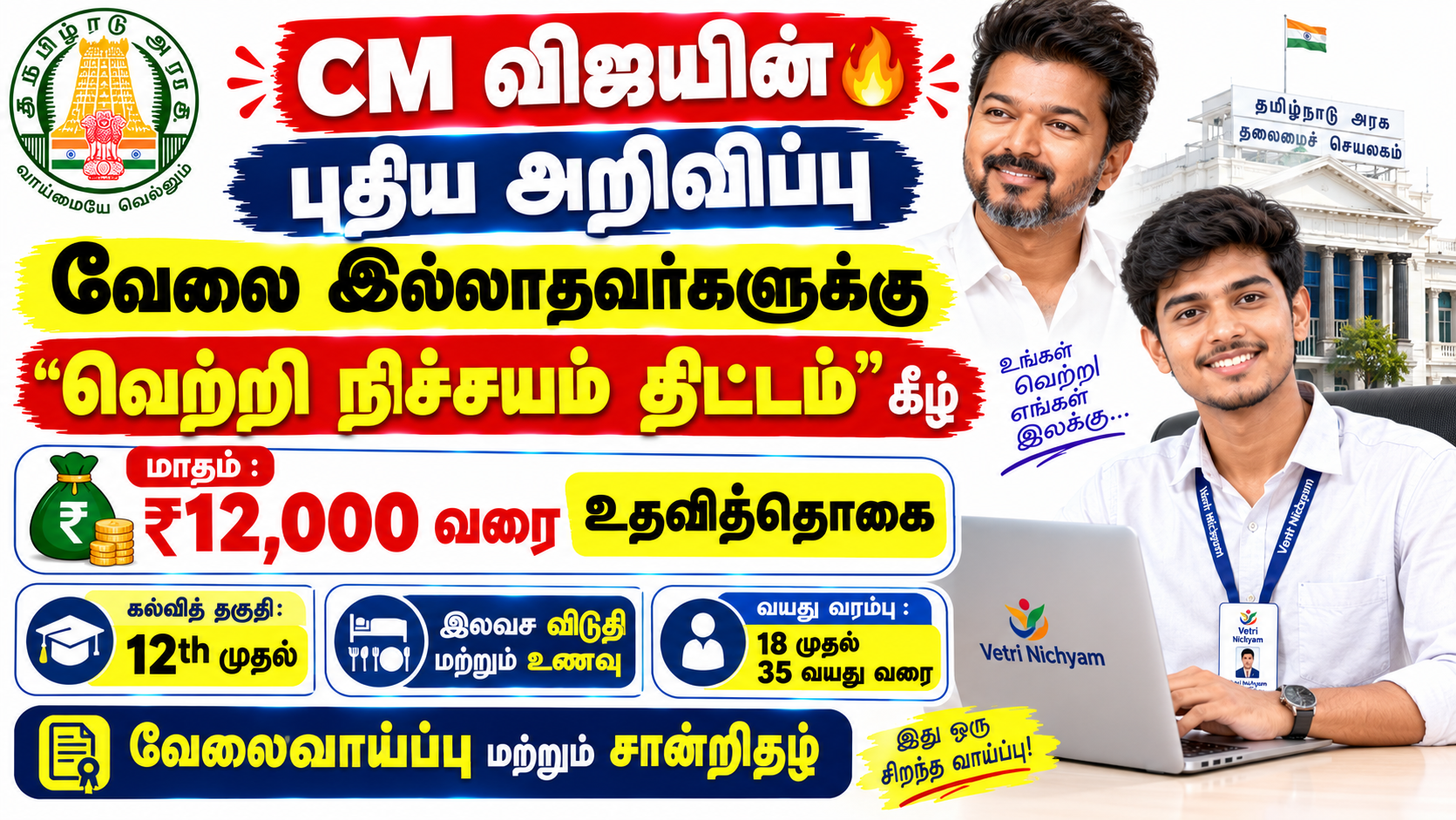
Vetri Nichayam Scheme Tamil Nadu 2026.Vetri Nichayam Scheme Tamil Nadu 2026 is a skill development initiative aimed at helping young people improve their professional abilities and prepare for employment opportunities. The programme focuses on connecting skill training with industry requirements so that candidates can develop practical knowledge and improve their chances of entering the workforce.
Young people who have completed school, ITI, diploma courses or graduation may explore suitable skill development programmes based on their qualifications and career interests. The initiative places importance on job-oriented learning, technical expertise and workplace readiness rather than academic qualifications alone.
Through industry-linked training, recognised skill certification and employment-oriented learning opportunities, Tamil Nadu’s skill development ecosystem aims to create a stronger connection between job seekers and employers. Candidates interested in manufacturing, healthcare, information technology, retail, logistics, renewable energy and other sectors can explore relevant courses through official skill development channels.
This article explains the objectives, eligibility considerations, training opportunities, potential benefits and important details associated with Vetri Nichayam Scheme Tamil Nadu 2026.
Vetri Nichayam Scheme 2026 – Overview
| Particulars | Details |
|---|---|
| Scheme Name | Vetri Nichayam Scheme |
| State | Tamil Nadu |
| Main Objective | Skill development and employability enhancement |
| Target Beneficiaries | Eligible youth and job seekers |
| Educational Background | Depends on the selected course |
| Training Focus | Industry-oriented and practical skills |
| Training Areas | Technical and non-technical sectors |
| Training Providers | Approved institutions and industry partners, where applicable |
| Certification | Subject to the selected programme |
| Placement Support | Depends on the course and training provider |
| Application Mode | Check the official scheme portal for current instructions |
| Official Information | Tamil Nadu Skill Development Corporation and Naan Mudhalvan channels |
Note: The exact eligibility rules, available courses, financial assistance and application process may vary by programme. Candidates should confirm the current details through official sources.
What Is the Vetri Nichayam Scheme?
Vetri Nichayam is associated with the broader objective of strengthening the skills and employment readiness of Tamil Nadu’s youth. The initiative aims to address a common challenge faced by job seekers: having educational qualifications but lacking the practical experience or specialised abilities required by employers.
Many industries seek candidates who can perform workplace tasks, understand modern technology, communicate effectively and adapt to professional environments. Skill-based training can help bridge this gap by providing learning opportunities that are more closely connected to actual job requirements.
Depending on the programme available, candidates may develop technical knowledge, digital skills, communication abilities and sector-specific expertise. These competencies can support applications for entry-level positions, specialised occupations and future career advancement.
The scheme’s relevance lies in encouraging young people to identify suitable career paths and develop skills that match the needs of the employment market.
Objectives of Vetri Nichayam Scheme Tamil Nadu
The broader goals of employment-oriented skill development include:
- Improve employability: Help candidates acquire practical abilities that employers value.
- Support unemployed youth: Provide opportunities to improve job readiness through suitable training.
- Reduce the skills gap: Align training content with changing industry expectations.
- Encourage career development: Help candidates identify occupations suited to their qualifications and interests.
- Promote technical education: Expand awareness of emerging technologies and specialised job roles.
- Strengthen industry connections: Encourage collaboration between training institutions and employers.
- Support inclusive growth: Improve access to skill development opportunities for eligible candidates from different backgrounds.
These objectives contribute to the development of a workforce capable of responding to Tamil Nadu’s evolving industrial and service-sector requirements.
Who Can Apply for Vetri Nichayam Scheme 2026?
Eligibility depends on the particular course or training programme offered. Candidates should carefully review the official notification before registering.
| Eligibility Factor | General Guidance |
|---|---|
| Age Limit | Check the age criteria specified for the selected programme |
| Educational Qualification | School education, ITI, diploma or degree, depending on course requirements |
| Employment Status | Unemployed and other eligible candidates, subject to programme rules |
| Location | Tamil Nadu residents may be prioritised where the programme requires it |
| Language Skills | Local-language or English proficiency may be required for certain jobs |
| Previous Experience | Required for some specialised or advanced training programmes |
| Documents | Educational certificates, identity proof and other requested records |
Candidates should not assume that every course is open to all applicants. Some programmes may be designed for freshers, while others may require specific qualifications, previous work experience or technical knowledge.
Skill Training Opportunities Under the Programme
Practical training can help candidates understand workplace responsibilities and prepare for specific occupations. Depending on the courses currently offered through authorised training partners, learning may include classroom instruction, laboratory practice, digital learning and industry exposure.
Potential areas of training include:
1. Information Technology: Computer fundamentals, digital applications, IT support, data management and other relevant technical skills.
2. Manufacturing and Engineering: Production processes, equipment handling, quality control, maintenance and industrial safety.
3. Banking and Financial Services: Customer service, financial operations, documentation and basic banking processes.
4. Healthcare: Relevant support roles, healthcare administration and other occupations for which candidates meet the required qualifications.
5. Retail and Customer Service: Sales support, customer relationship management, inventory operations and communication skills.
6. Logistics and Supply Chain: Warehouse operations, inventory handling, transportation support and supply chain fundamentals.
7. Renewable Energy: Relevant introductory or specialised training in solar energy, electric vehicles and associated technical occupations.
8. Hospitality and Tourism: Front-office operations, hospitality services, customer handling and related professional skills.
The actual course list, admission availability and training duration must be checked through the applicable official programme listing.
Training Partners and Industry-Based Learning
Training providers play an important role in helping candidates develop practical skills. Depending on the programme structure, training may be delivered through approved educational institutions, technical centres, private training organisations or industry-linked facilities.
Industry-oriented learning can help participants understand how their skills are used in professional environments. Candidates may also receive guidance on workplace behaviour, communication, teamwork, interview preparation and job application procedures.
Some programmes may incorporate practical assignments, assessments or exposure to workplace equipment. However, the training structure and facilities will depend on the selected course and its authorised provider.
Before enrolling, applicants should verify the training centre’s approval status, course syllabus, duration, certification arrangements and any applicable fees.
Skill Registry and Employment Opportunities
A skill registry can help organise information about trained candidates and their qualifications. When implemented through an authorised platform, such a system may help employers identify individuals whose skills match available vacancies.
For candidates, maintaining accurate educational and training details can make it easier to demonstrate their capabilities when applying for suitable positions. Employers may benefit from being able to identify applicants with relevant training and certifications.
Nevertheless, registration in a skill database does not automatically guarantee an interview, job offer or appointment. Candidates should continue applying for suitable vacancies and prepare for any selection tests or interviews.
Factory Skill Schools and Workplace Training
Factory-based training is a practical approach in which participants learn skills connected to industrial operations. Depending on the specific programme, training may take place in a simulated workplace or an actual industrial setting.
A recruit-train-deploy model, where offered, connects recruitment needs with structured training and potential deployment opportunities. This approach can help employers identify suitable candidates and provide training that reflects their operational requirements.
Candidates interested in manufacturing, assembly, machinery operation, maintenance and related occupations should check whether an appropriate course is available in their preferred location.
Participation in workplace training does not itself establish a guarantee of permanent employment. Applicants should review the programme’s placement conditions before accepting an offer.
Recognition of Prior Learning (RPL)
Recognition of Prior Learning is a skill assessment approach designed to evaluate competencies that individuals may have developed through previous work experience or informal learning.
For example, a person who has worked in a trade for several years may already possess practical abilities but may not hold a formal certificate. An applicable RPL programme can assess those existing skills against prescribed standards.
Potential benefits include:
- Formal assessment of existing occupational abilities.
- Identification of skill gaps that may require further learning.
- Certification where the candidate meets the applicable requirements.
- Better presentation of qualifications during job applications.
- Opportunities to pursue additional training and career development.
RPL availability, assessment procedures and certification recognition depend on the relevant programme. Candidates should check the authorised assessment arrangements before registering.
Key Benefits of Vetri Nichayam Skill Development
The main potential advantages of suitable skill development programmes include:
| Benefit | How It May Help |
|---|---|
| Practical Knowledge | Builds familiarity with job-related tasks |
| Industry-Relevant Skills | Helps candidates prepare for selected occupations |
| Career Guidance | Supports better understanding of suitable career paths |
| Certification | Provides evidence of skills where certification is included |
| Interview Preparation | Improves confidence and professional presentation |
| Placement Assistance | May connect eligible trainees with employers |
| Career Progression | Supports further learning and skill improvement |
| Emerging Technology Exposure | Helps candidates explore developing industries |
The availability of free training, financial incentives, vouchers or placement assistance must be confirmed separately. These benefits should not be assumed to apply to every candidate or course.
How to Check Vetri Nichayam Scheme Application Details
Candidates should use official government websites to identify currently available training opportunities and verify registration requirements.
Follow these steps:
- Visit the official website of the Tamil Nadu Skill Development Corporation or the relevant Naan Mudhalvan platform.
- Look for current skill development schemes, training announcements or course listings.
- Read the eligibility conditions and educational requirements carefully.
- Check the course location, duration, training provider and available seats.
- Review whether the programme is free and whether any financial support is offered.
- Complete the online registration process if applications are open.
- Upload the requested documents and submit the form according to the official instructions.
- Save the acknowledgement or registration number for future reference.
Official websites to check:
🔗Vetri Nichayam Scheme Tamil Nadu 2026 Tamil & Apply Link Table 🔗
| 🔗 Resource | 👉 Apply/View Link |
|---|---|
| 🧾 Vetri Nichayam Scheme Tamil Nadu Official Career Page | Click Here Link |
| 🌐 Vetri Nichayam Scheme Tamil Nadu Tamil Notice Link | Click Here Link |
| 📝 Vetri Nichayam Scheme Tamil Nadu Apply Link | Apply Now Link |
If a dedicated Vetri Nichayam application notification is published, applicants should follow the instructions and dates mentioned in that official announcement.
Documents to Keep Ready
Depending on the course, applicants may be asked to provide some of the following documents:
- Aadhaar card or another accepted identity document.
- Recent passport-size photograph.
- Educational certificates and mark sheets.
- ITI, diploma or degree certificates, if applicable.
- Address or residence proof, where required.
- Updated mobile number and email address.
- Experience certificates for courses that require previous employment.
- Bank account information if the programme specifically requires it for an eligible benefit.
Submit only the documents requested by the official application process. Do not share sensitive personal or banking details through unofficial links or unverified messages.
Important Instructions for Applicants
Before registering, verify the latest scheme details, course availability and eligibility requirements. Be cautious of individuals or websites promising guaranteed government jobs, guaranteed salaries or compulsory payments in exchange for selection.
Use official portals to confirm whether a training programme is authorised and whether registration or training involves any fee. Placement assistance should not be confused with a guaranteed appointment.
Candidates should also compare course content with their career goals. A course that offers recognised training and practical experience in a relevant field may be more useful than choosing a programme solely because it advertises quick employment.
Conclusion
Vetri Nichayam Scheme Tamil Nadu 2026 is a relevant topic for young job seekers exploring skill development and career preparation opportunities. Industry-oriented training, practical learning, professional certification and employment guidance can help eligible candidates strengthen their profiles and prepare for changing workforce requirements.
Students, fresh graduates, diploma holders, ITI candidates and experienced workers should identify the programmes that match their qualifications and interests. Before applying, check the latest official announcements for eligibility, course availability, application dates, fees and placement-related benefits.
Developing the right skills can improve career readiness, but applicants should remember that actual employment depends on several factors, including qualifications, performance, vacancies and employer selection criteria.
Vetri Nichayam Scheme Tamil Nadu 2026: Check eligibility, skill training opportunities, benefits, career options, application details and official websites.
Vetri Nichayam Scheme Tamil Nadu 2026, Vetri Nichayam Scheme eligibility, Vetri Nichayam Scheme apply online, Vetri Nichayam skill training, Tamil Nadu skill development scheme 2026, Tamil Nadu government skill training for youth, free skill development courses Tamil Nadu, Tamil Nadu youth employment scheme, TNSDC skill training 2026,

